
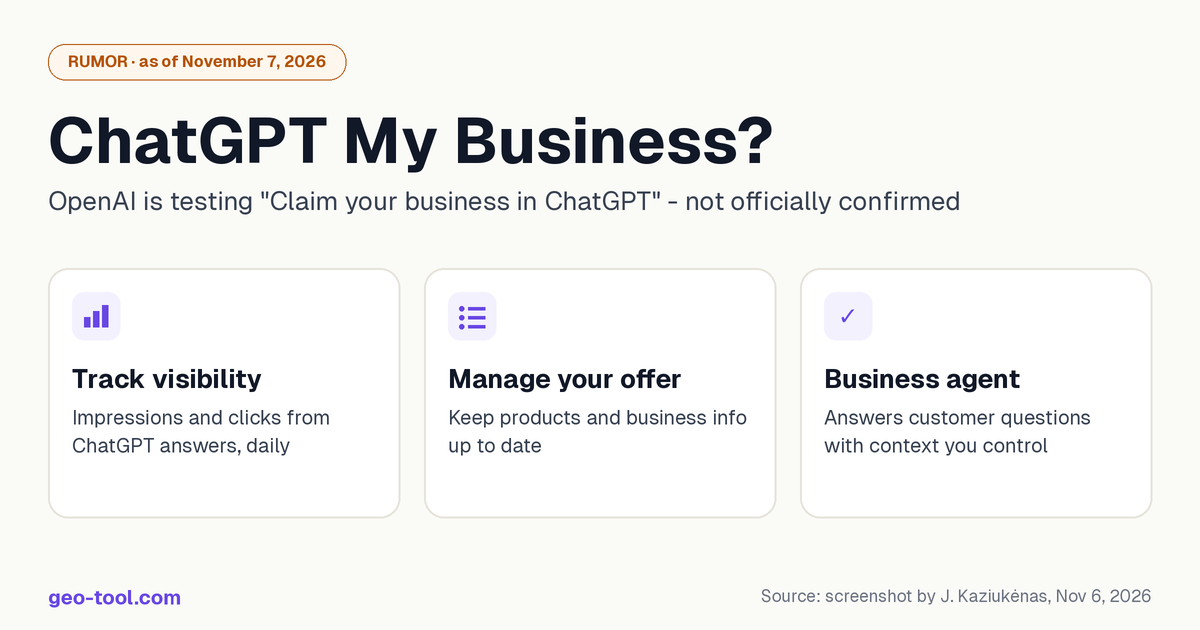
In short: OpenAI appears to be building its own business profile for ChatGPT. A screenshot shared on November 6, 2026 reads "Claim your business in ChatGPT": businesses would claim a profile, see how often ChatGPT mentions them, manage their own products, and let a business agent answer customer questions. OpenAI has not confirmed it. It is a well-sourced rumor, not a fact. If it ships, it would be for ChatGPT what Google My Business and Search Console were for Google. And it would make one thing very clear: if you want to show up in AI answers, you need clean, structured data.
What exactly surfaced
Juozas Kaziukėnas, founder of Marketplace Pulse, shared the screenshot on LinkedIn on November 6, 2026. The same day, Dylan Ander and Edward Sturm spread it on X, Sturm with the line "OpenAI is releasing its own Google Search Console." Search Engine Roundtable and Technori covered it on November 6.
The banner, labeled "unreleased/beta", says:
- "Claim your business in ChatGPT" with the subline "Unlock your business agent and more ways to manage how your business shows up."
- See how your business shows up: track how often your business is mentioned in ChatGPT conversations.
- Show customers what you offer: add your latest products and keep your business info up to date.
- Help customers make decisions: a business agent answers customer questions "with context you control".
- Fine print: you need to verify that you are authorized to represent the business.
According to Search Engine Roundtable, Kaziukėnas adds that the tool measures impressions and clicks: how often a business appears in ChatGPT responses and how often people click links to its website, tracked daily as a chart. It does not show prompts, user data, or competitor benchmarks. Verification works, for example, by connecting your Shopify store. He sees it as part of a larger "Business Hub" and says it "seems to be getting close to launch."
What is solid: the banner exists, and several people shared it independently. What is not: whether, when, in which countries, and in what scope OpenAI launches it. Technori checked OpenAI's official pages and release notes and found no announcement. So we treat it as what it is: a strong signal.
Why the Google My Business comparison fits
If you have worked in marketing for a few years, you know this pattern. Over two decades, Google built step by step how businesses show up in search and how they can control it:
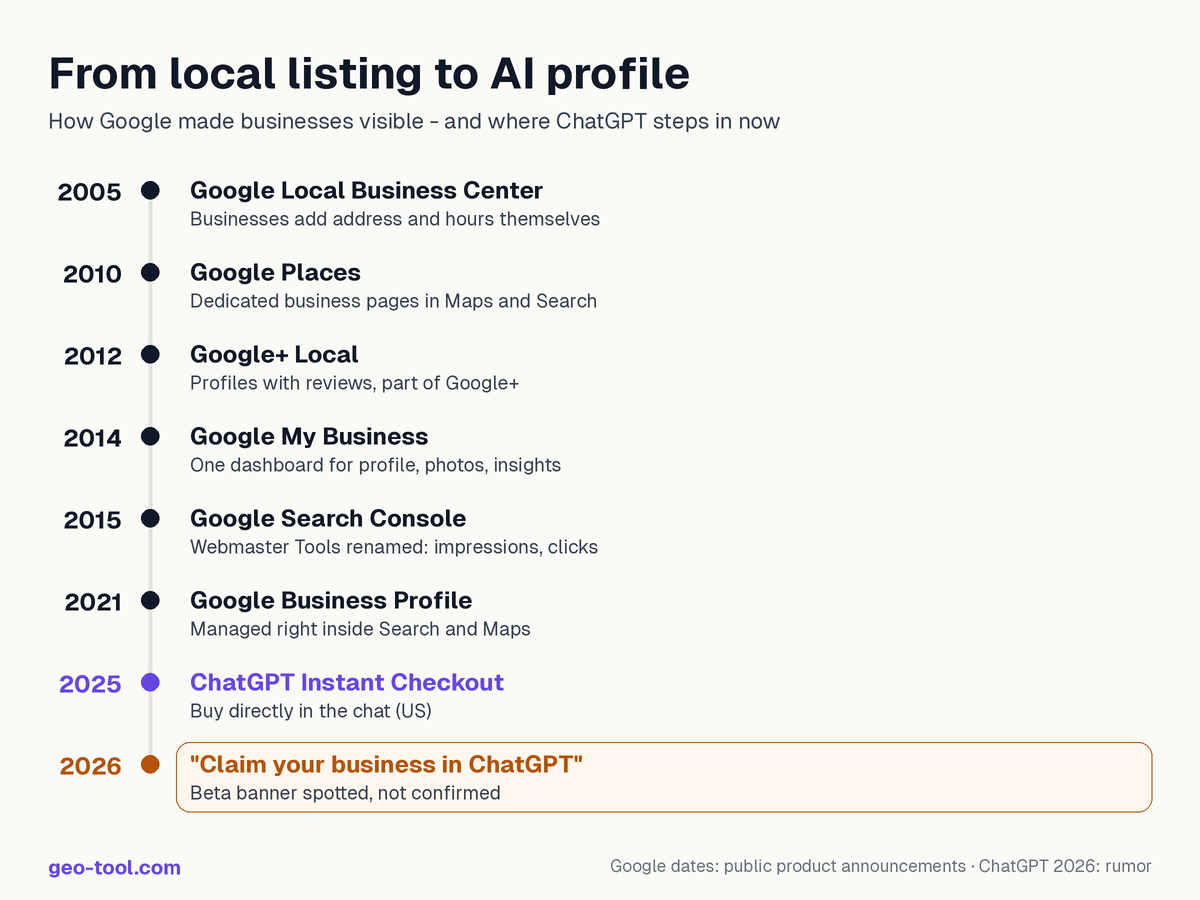
- 2005, Google Local Business Center: for the first time, businesses could add their address, phone number, and hours to Google themselves.
- 2010, Google Places: dedicated business pages in Maps and Search.
- 2012, Google+ Local: profiles with reviews, tied into Google+.
- 2014, Google My Business: one dashboard for profile, photos, posts, and insights.
- 2015, Google Search Console: Webmaster Tools gets its current name. Impressions, clicks, queries, indexing.
- 2021, Google Business Profile: the profile is managed right inside Search and Maps.
Two tools, two jobs: the business profile tells Google who you are and what you offer. Search Console shows you how people find you. The ChatGPT banner combines both in one product and adds something new on top: an agent that talks to customers on your behalf.
What Google My Business changed for businesses
The biggest effect was not the dashboard. It was the realization that Google talks about your business whether you manage your profile or not. Google assembled unclaimed listings from directories, review sites, and user edits. Wrong hours, old phone numbers, strangers' photos: if you did not take care of it, you still showed up, just with other people's data.
Businesses that claimed early and kept their data clean built an advantage that compounded for years: more calls, more direction requests, more reviews. A whole industry grew around these profiles: local SEO, review management, listings management. The lesson applies again today:
- The platform describes you anyway. The only question is whose data it uses.
- Consistent data everywhere beats a beautiful profile in one place.
- Early movers collect history, reviews, and trust that latecomers cannot buy.
Side by side: Google Business Profile, Search Console, ChatGPT
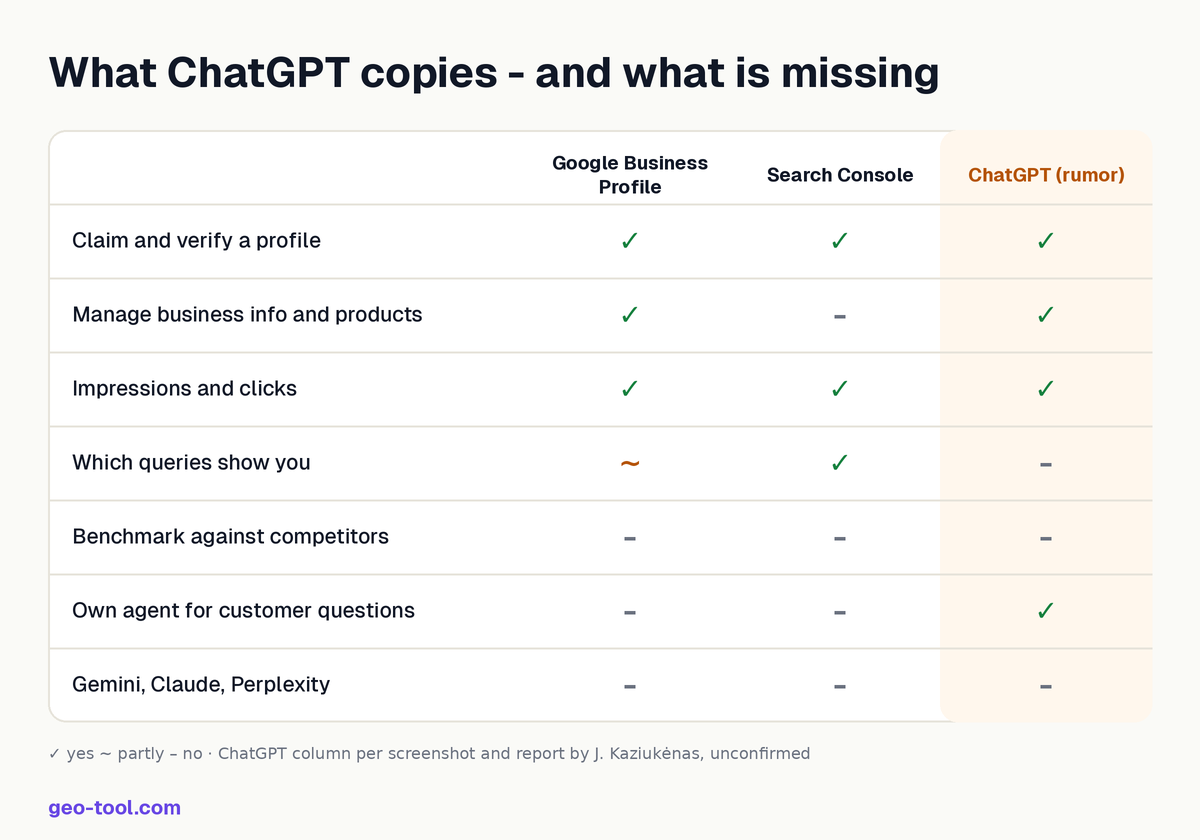
Put the banner and Kaziukėnas's description next to Google's two tools and a clear picture emerges:
- Claim and verify: all three have it. Google uses postcard, phone, video, or domain verification; ChatGPT reportedly uses a store connection, for example.
- Manage business info and products: core of the Google profile, and per the banner part of ChatGPT too. Search Console does not do this.
- Impressions and clicks: Search Console and the business profile provide them; ChatGPT reportedly will, daily.
- Which queries show you: this is where it gets interesting. Search Console shows queries, the Google profile at least shows search terms. ChatGPT reportedly shows no prompts. You see that you were mentioned, not what question triggered it.
- Competitor benchmarks: none of the three offer them.
- Your own agent: the truly new part. Google had a business chat with Business Messages and shut it down in 2024. ChatGPT now bets on an AI agent that answers with your content.
- Other AI systems: Gemini, Claude, and Perplexity appear in none of these dashboards. Each one only measures its own platform.
Why data now matters more than copy
A search engine shows ten links and lets people decide. An AI assistant decides first: it summarizes, recommends, compares prices, names two or three vendors. To do that, it needs facts it can read reliably. What it does not know for sure, it leaves out or takes from third parties.
That is exactly what the banner targets. "Show customers what you offer" and "keep your business info up to date" translates to: give us your data directly, in a form we can process. Same logic as Google: if you do not supply your data, you get described with someone else's. In AI answers today, that is often comparison lists, forums, and review sites. We covered this in detail in our post on listicles and Reddit as AI sources.
What "structured" means in practice
- One source of truth: name, address, offer, prices, and shipping terms come from one system, not five spreadsheets.
- Structured data on your website: Organization, Product, Offer, FAQ, and LocalBusiness as JSON-LD, matching the page and the visible content.
- Product data as a feed: most shop systems already provide one. OpenAI introduced product feeds for buying in the chat. A clean feed gets you ready for a business profile.
- Readable for crawlers: OpenAI's search crawler is called OAI-SearchBot. Block it in robots.txt or your firewall and you drop out of the sources. Key content should be in the HTML without JavaScript.
- Answers to real buyer questions: pages that settle exactly the questions buyers ask an assistant, with clear statements and evidence.
Agents do business - without opening your website
The third point on the banner reaches furthest. A business agent that answers customer questions "with context you control" means part of the sales conversation happens inside ChatGPT, not on your website. Since September 2025, users in the US can buy directly in ChatGPT with Instant Checkout. Put the two together and you get a path where customer and business only meet through agents.
For businesses, that shifts the question. It used to be: how do I get the click? Now it is also: what does the agent know about me, and is it right? An agent only sells what it understands. If prices, availability, or scope contradict each other, it would rather recommend a vendor where everything lines up.
That is why we work on both ends at GEO Tool. On one side, the website that convinces people. On the other, data, structure, and interfaces that agents can read and use. Being findable today means being understood by people and by machines.
So will there soon be a "ChatGPT My Business"?
Our take, clearly labeled as a take: probably yes, in some form. The banner looks finished, several people saw it independently, and Kaziukėnas reports first traces since August. The logic is the same one that led Google to the business profile: a platform that talks about businesses needs reliable data from those businesses. And a dashboard with impressions is the natural way to get businesses onto the platform.
A lot remains open: launch date, whether it starts with Shopify merchants or the US only, whether it costs money, how exactly the agent works, and whether ChatGPT ads tie into it. We will update this post as soon as OpenAI confirms anything.
What this means for GEO
An official OpenAI dashboard would be good news for everyone working on generative engine optimization. It confirms that visibility in AI answers is measurable and manageable, and that it matters for revenue. But it does not replace what businesses actually want to know:
- For which questions am I mentioned, and for which not? The dashboard reportedly shows no prompts.
- Who gets mentioned instead of me? No competitor benchmark.
- How do I look in Gemini, Claude, and Perplexity? Each platform only measures itself.
- Which sources does the AI use to talk about me, and which of them can I influence?
- What do I need to change to improve?
That is the job of GEO: know the questions buyers ask, measure who gets named there, and improve website, data, and sources so your brand becomes the most reliable answer. Search Console worked the same way: it did not make SEO obsolete, it made it measurable.
How to get ready now
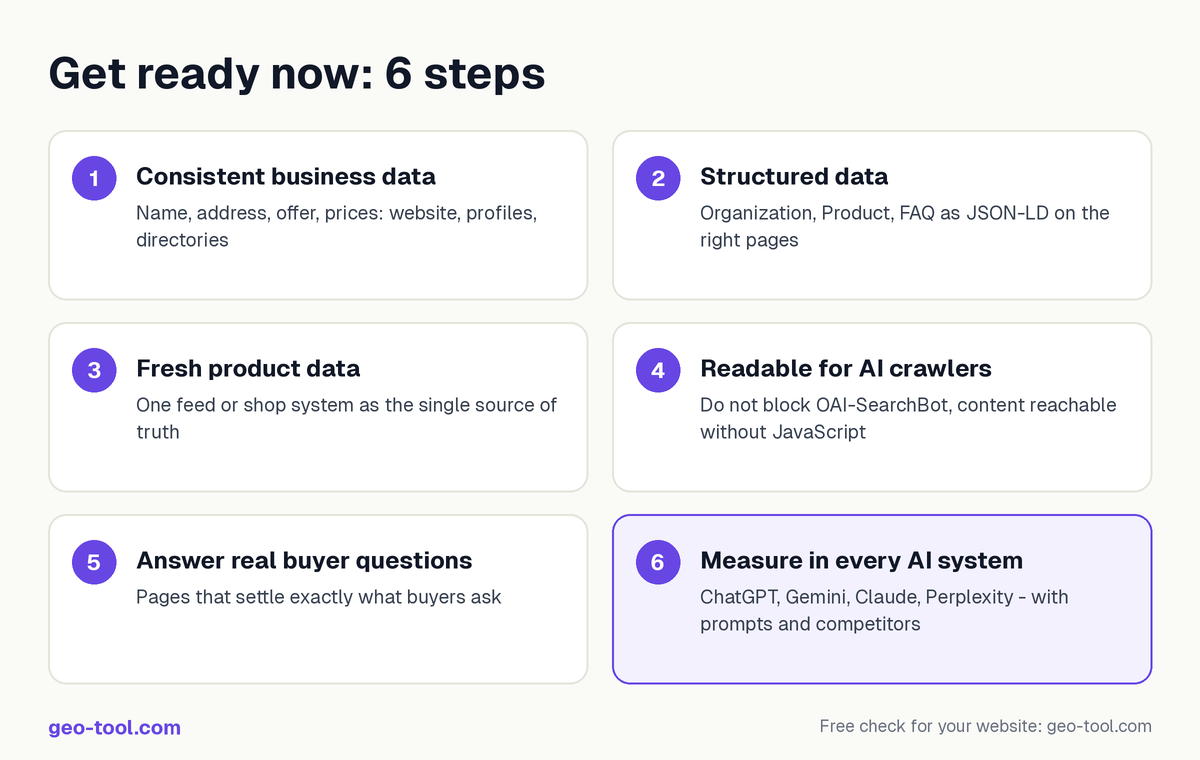
- Consistent business data: align name, address, offer, and prices across your website, Google profile, directories, and social profiles.
- Check structured data: Organization, Product, and FAQ as JSON-LD, never contradicting the visible text.
- Product data from one source: your shop or PIM as the only source, feed updated regularly. Shopify merchants are reportedly well positioned for verification.
- Allow crawlers: check robots.txt and firewall for OAI-SearchBot, Googlebot, and other AI crawlers; make content reachable without JavaScript.
- Answer buyer questions: answer the ten most important pre-purchase questions clearly, each on a fitting page.
- Measure before the dashboard arrives: if you already know where you stand in ChatGPT, Gemini, Claude, and Perplexity, you have a baseline and can put an OpenAI launch in context right away.
You can check the technical part right now: the free GEO Check shows whether your website is readable for AI crawlers, where structured data is missing, and where trust signals are thin. We do not care about a high score for its own sake; we care that you get found. How visible you are in AI answers today is what GEO Tool measures, with your real customer questions across ChatGPT, Gemini, Claude, and Perplexity, including competitors and sources. For a market overview, see our GEO tools comparison. Online stores should look at GEO for ecommerce.
Sources
- Juozas Kaziukėnas (Marketplace Pulse), LinkedIn post with screenshot, November 6, 2026
- Search Engine Roundtable: OpenAI Working On ChatGPT Tools For Business For Analytics & Citations, November 6, 2026
- Technori: Is OpenAI Planning to Release a Tool to Track ChatGPT Mentions?, November 6, 2026
- Dylan Ander on X and Edward Sturm on X, November 6, 2026
FAQ
Is "Claim your business in ChatGPT" live yet?
No, not officially as of November 7, 2026. There is a screenshot of a beta banner that Juozas Kaziukėnas shared on November 6. OpenAI has not commented.
Is this a Google My Business for ChatGPT?
It looks like it. Per the banner, businesses would claim their profile, manage products and business info, and let their own agent answer customer questions. On top come impressions and clicks, like in Google Search Console.
Will the dashboard show which questions I am mentioned for?
According to Kaziukėnas, no. It reportedly shows impressions and clicks, but no prompts, no user data, and no competitor benchmarks.
How do you verify your business?
The banner only says you need to verify you are authorized to represent the business. Kaziukėnas names connecting your Shopify store as one example. Other methods are unknown.
Do I still need GEO then?
Yes. A dashboard shows how often ChatGPT mentions you. GEO makes sure you get mentioned, for the right questions, in every AI system, and with correct information. Structured data, readable pages, and strong sources remain the foundation.
Ready for better AI visibility?
Test now for free how well your website is optimized for AI search engines.
Start Free AnalysisRelated GEO Topics
Share Article
Make this blog a preferred source
One click and Google will prioritise articles from geo-tool.com in Top Stories and Discover. The setting applies to your account only and can be undone at any time.

About the Author
 G
- Structured data for AI crawlers
- Include clear facts & statistics
- Formulate quotable snippets
- Integrate FAQ sections
- Demonstrate expertise & authority