
In short: On November 25, 2026, Cloudflare introduced Search for Agents, exposing a standardized endpoint (/.well-known/search) so AI agents can query any website for matching Markdown passages instead of brute-force crawling heavy HTML pages. Why this shift matters strategically: in the near future, far fewer searches will come from humans opening ten browser tabs—and far more will come from autonomous research, procurement, and comparison agents. While /.well-known/search is not yet a proven Google ranking signal and Cloudflare's hosted toggle carries real cost and lock-in caveats, the underlying shift toward targeted, machine-readable retrieval will decide which brands agents find and cite.
Why the Future Belongs to Searching AI Agents
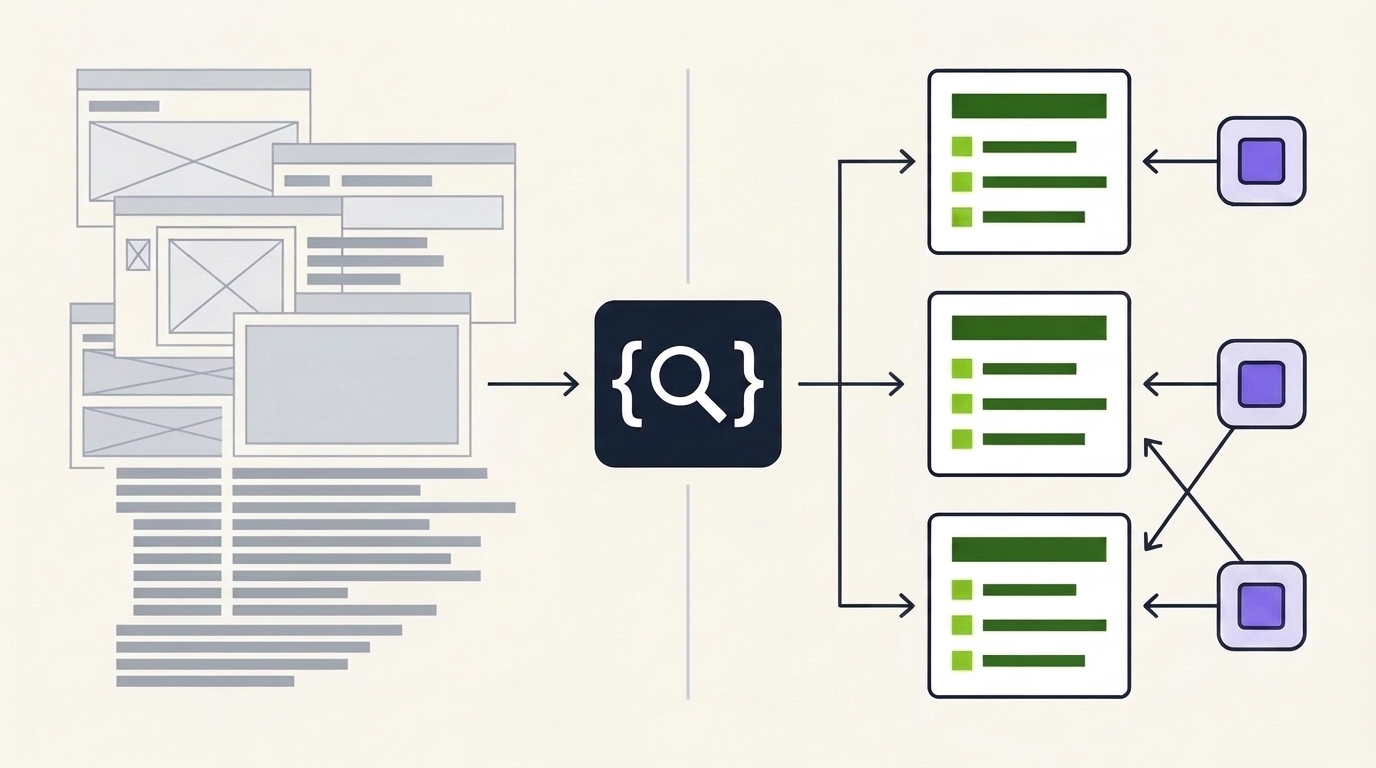
Traditional web search was built around human eyes in a browser: a crawler downloads full HTML pages, builds an index, displays ten blue links, and a person opens four tabs to compare pricing, integrations, and compliance details. Autonomous AI agents break that workflow at three bottlenecks:
- Token and context-window waste: A typical marketing page carries hundreds of kilobytes of navigation menus, cookie banners, tracking scripts, and layout markup. When an agent fetches ten pages just to verify one pricing tier, it burns latency and context budget on structural noise.
- Parallel multi-step retrieval instead of browsing: Research and buying agents fire dozens of narrow sub-queries per user request—checking pricing, deployment region, API specs, limits, and vendor comparisons. They need exact passages in milliseconds, not visual hero banners.
- Most non-visual agents do not execute JavaScript: If core product facts only render client-side in the browser DOM, lightweight HTTP agents and crawlers receive an empty shell.
That is why agent search is becoming critical web infrastructure. Sites engineered solely for visual browsers become slow, expensive, or invisible to working AI agents. Sites that expose crisp, structured facts directly reduce friction for the very systems preparing tomorrow's B2B buying shortlists.
How Search for Agents Works Technically
Cloudflare's November 25 announcement combines several emerging web conventions into a single predictable contract on a domain:
- Standardized
/.well-known/searchendpoint: Any enabled domain exposes a uniform search endpoint at the same well-known path, eliminating guesswork across custom site-search forms. - Automatic HTML discovery tags: Pages advertise
<meta name="agent:endpoint">and<meta name="agent:instructions">inside the document<head>so autonomous agents know where and how to query without hardcoding domain rules. - Standard
GETand HTTPQUERY(RFC 10008): Alongside classicGET ?q=...requests, Cloudflare supports the safe, idempotent HTTPQUERYmethod (RFC 10008) for sending plain-text or JSON query payloads in the request body. - Raw Markdown chunks instead of synthesized fluff: Crucially, the endpoint does not generate an AI summary. It returns top matching text passages formatted in clean Markdown with source URLs and relevance scores, letting the calling agent reason over primary sources with its own model.
Comparing robots.txt, llms.txt, Accept: text/markdown, and /.well-known/search
| Standard / Signal | Role for AI Systems | Format | Required or Optional? |
|---|---|---|---|
robots.txt + server-rendered HTML |
Grants crawler access and serves readable content without JS | Plaintext / HTML | Non-negotiable foundation |
llms.txt |
Curated site overview and canonical entity facts | Markdown / Plaintext | Optional orientation file |
Accept: text/markdown |
Returns a specific page URL directly as Markdown instead of HTML | text/markdown |
Optional, saves tokens on single-page fetches |
/.well-known/search |
Queries the full site index and returns matching chunks directly | Markdown (or JSON) | New (Nov 2026), built for agentic retrieval |
Three Practical Caveats in Cloudflare's Implementation
Recognizing the long-term importance of agent search does not mean buying into hype. Before flipping Cloudflare's dashboard toggle, teams should weigh three real constraints:
- Not a proven ranking shortcut today: Search for Agents launched in beta. There is no evidence yet that ChatGPT, Perplexity, or Google AI Overviews cite domains more often simply because
/.well-known/searchis live. Clean HTML, authority, and verifiable facts still do the heavy lifting. - The website owner pays for incoming agent queries: Beyond Cloudflare AI Search's free monthly allowance (1,000 semantic and 1,000 full-text queries), queries cost $0.75 per 1,000 requests. If automated agents or scrapers hammer your search endpoint, your billing meter absorbs the traffic.
- Daily crawl caps and cloud lock-in: On Workers Free plans, indexing is capped at 500 pages per day. More importantly, handing your full content index to a US edge provider creates GDPR and vendor lock-in questions for European companies.
How We Built Search for Agents on geo-tool.com Without Cloudflare
We agree with the architectural direction, not the vendor lock-in. So we implemented the same open discovery contract directly on geo-tool.com—running on our own EU servers in Germany (netcup), with zero per-query fees and zero external indexing proxy.
curl -s "https://www.geo-tool.com/.well-known/search?q=pricing&locale=en&limit=2"The endpoint searches our curated product and pricing pages, browser tools, glossary definitions, and indexed blog posts directly in memory and returns Markdown passages with YAML front matter, relevance scores, and canonical URLs (or JSON when requested via Accept: application/json). Every page also advertises agent:endpoint and agent:instructions in the HTML <head>, complementing our existing Accept: text/markdown negotiation on homepages.
We also updated our free 37-point GEO technical check and hosted MCP server (/api/mcp): GEO Tool now automatically detects whether any inspected domain serves /.well-known/search, agent:endpoint, and Accept: text/markdown—surfaced transparently as an informational signal with zero score penalty while adoption is still early. If you are looking for GDPR-compliant AI visibility tooling hosted in Germany, see our GEO Tool Europe overview.
Checklist: How to Prepare Your Site for Searching AI Agents Now
- Serve core facts in initial HTML: Verify that pricing, capabilities, and answers exist in server-rendered HTML without relying on client-side JavaScript.
- Make every section self-contained (chunk-ready): When an agent search endpoint extracts a single paragraph, that passage should name the brand, product, price, and scope explicitly instead of relying on vague pronouns like "this tool" or earlier headings.
- Keep AI search crawlers unblocked in robots.txt: Do not block bots such as
OAI-SearchBot,PerplexityBot, orClaude-SearchBotif you want agents to discover your pages. - Audit technical readiness first: Run your URL through our free GEO Score check to inspect crawlability, non-JS readability,
llms.txt, and agent discovery in one pass. - Add your own lightweight endpoint selectively: When agents frequently query your docs, pricing, or catalog, serving a lean
/.well-known/searchroute directly from your own stack avoids external query billing and keeps data under your control.
Sources
- Cloudflare Blog: Introducing Search for Agents (November 25, 2026)
- Live example: GEO Tool Agent Search endpoint (/.well-known/search)
Frequently Asked Questions
Do I need Cloudflare to offer /.well-known/search?
No. The /.well-known/search path and the agent:endpoint / agent:instructions meta tags are open web conventions. Any backend—Next.js, Node, WordPress, or TYPO3—can expose the endpoint directly while keeping full control over privacy, indexing, and cost.
Will I lose ChatGPT or Google visibility today without /.well-known/search?
Not right now. Major AI search platforms still rely primarily on web search indexes, sitemaps, and direct HTML crawling. That is why GEO Tool reports agent discovery as an informational signal without penalizing your GEO Score.
What is the difference between llms.txt and Search for Agents?
llms.txt is a static directory listing key pages and entity context for a domain. /.well-known/search is a live query interface: an agent submits a specific question and receives only the matching text passages in Markdown.
Why does agent search matter so much for the future of the web?
Because software agents are increasingly performing multi-step research, vendor shortlisting, and price checks autonomously. Websites that deliver clean, self-contained Markdown passages via predictable endpoints integrate faster, cheaper, and more reliably into agent workflows than sites buried in heavy HTML.
Ready for better AI visibility?
Test now for free how well your website is optimized for AI search engines.
Start Free AnalysisRelated GEO Topics
Share Article
Make this blog a preferred source
One click and Google will prioritise articles from geo-tool.com in Top Stories and Discover. The setting applies to your account only and can be undone at any time.

About the Author
 G
- Structured data for AI crawlers
- Include clear facts & statistics
- Formulate quotable snippets
- Integrate FAQ sections
- Demonstrate expertise & authority